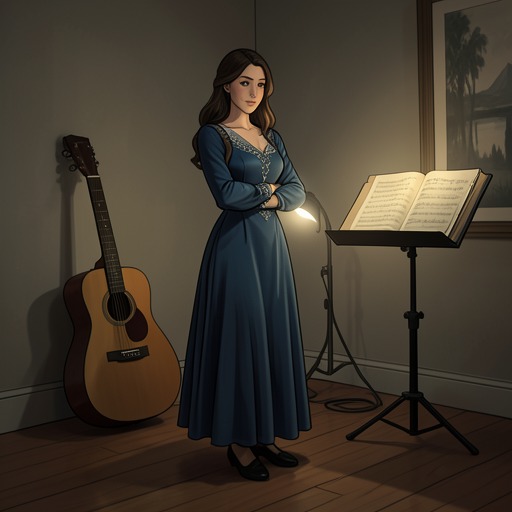
Music as emotional connection and an expression of truth
Daisy Jones & the SixMusic in the novel is more than performance or sound: it is a means by which private feeling becomes communicable, sometimes before the people experiencing it can put that feeling into words. For Daisy Jones, a song can make gratitude audible, connect her to strangers, and affirm her desire to write from her own life. The same expressive power appears in the music of Daisy Jones & The Six, where voices and lyrics can hold tenderness and disappointment together.## Feeling Made Shareable One of Daisy Jones’s clearest memories of friendship with Simone Jackson is a drive down La Cienega, probably in Daisy’s BMW. The Record Plant was still there, and the two were listening to Carole King’s Tapestry; when “You’ve Got a Friend” came on, they sang along loudly. Daisy was also listening to the lyrics, and their meaning made her feel thankful for Simone. The song does not create their bond so much as give Daisy a way to recognize and feel its shape: she knows there is someone in the world who would do anything for her, and for whom she would do the same.
The moment turns on a small exchange rather than a speech. Daisy becomes tearful and begins to speak, but Simone nods and says that she feels the same. The song has brought them to a feeling they share, and their mutual recognition completes what the lyrics began. Music here acts as an emotional language: it allows Daisy to approach an intimate truth, while Simone’s response confirms that the truth belongs to both of them. Their singing is not presented as a public performance or an ambition to impress; its significance lies in the closeness it makes perceptible.
That intimacy also clarifies why music matters to Daisy beyond pleasure or celebrity. She describes the words, emotions, stories, and truth that can flow out through a song as more important than the sounds, crowds, or good times around it. The image of music digging into the chest gives the process a physical force: songwriting reaches toward something felt but not yet fully understood. For Daisy, music is not simply a polished account of emotion after the fact. It can uncover the feeling and make it available to someone else.## The Truth of a Voice Daisy’s performance of “When You Fly Low” gives that idea a public form. She had worked on the song and polished it from beginning to end; onstage, she accompanied herself with a tambourine and the stomp of her feet, while Eddie Loving tapped a beat against the body of a guitar. The audience watched closely. Daisy describes the exhilaration not as a response to spectacle but as the experience of singing words she had written herself and felt in her heart.
The decisive change comes through the audience’s attention. Daisy sees people at the front listening to her, people from another country whom she has never met, and feels connected to them in a way she had not felt connected to anyone before. The song carries personal authorship across that distance: the listeners need not know Daisy’s history for her words to reach them. Her performance strengthens her wish to release an album of her own songs, making connection a reason to claim authorship rather than a substitute for it.
The scene is also important because the people around Daisy register what her performance reveals. Billy Dunne is backstage watching her and Eddie; afterward, he acknowledges that Daisy was better than he had realized. His response marks a shift in recognition, while the performance itself gives Daisy evidence of what she wants to do. The song has not merely entertained a crowd. It has shown Daisy that feelings made into her own words can travel beyond her and still be understood.## Voices in Tension On “Honeycomb,” Daisy’s voice meets Billy Dunne’s in a different kind of connection. Rock critic Nick Harris describes the contrast between his deep, smooth voice and her higher, raspier one: Billy’s vulnerability and Daisy’s fragility combine in a call-and-response that seems effortless. Their voices do not become identical; their difference is what lets the exchange feel like a conversation. Each voice gives the other something to answer, turning musical arrangement into an expression of relation.
The song’s emotional force rests on a tension between promise and uncertainty. Its call-and-response tells of a romantic, idealized future that may never arrive. The music approaches sweetness closely enough to risk sentimentality, but the ending undercuts it. Instead of resolving into a simple promise that love will work out, the song retains the possibility of failure. Its feeling is therefore not less sincere because its future is uncertain. The uncertainty is part of what the song expresses.
That balance distinguishes emotional truth from uncomplicated optimism. The voices can suggest tenderness and shared possibility without proving that the imagined future will come to pass. In Harris’s account, what holds the listener is precisely this mixture: the duet feels heartfelt, but its ending knows that things do not always work out. Music gives both sides of that feeling room to coexist, rather than forcing one to cancel the other.## Song, Image, and Public Meaning The novel also places music within the wider work of making an album and shaping how its makers will be seen. While the band was considering how to market its record, Rod Reyes brought in photographer Freddie Mendoza and played him early tracks. Mendoza’s response was to imagine the cover in the desert mountains. The photograph that became especially powerful captured Daisy and Billy at opposite ends of the group, looking at one another for a split second while the others faced the camera. The image gave the music a public visual counterpart: a moment of attention between its two singers that viewers could interpret without being told what it meant.
Mendoza later singled out a photograph of their torsos, in which their faces were not visible and the space between them was filled by clear blue sky. He described the image as emotionally immediate and said that viewers could fill in the gaps for themselves. He also noticed an object in Daisy’s pocket that looked to him like a vial, though he did not know what it was; his assumption that it might contain pills or powder was an interpretation, not a confirmed identification. The cover’s force thus came partly from what it showed and partly from what it left unresolved. Like a song, it invited a public to make meaning from suggestive details.
Elaine Chang’s account of the cover emphasizes a different kind of truth: Daisy’s self-possession. Although the image exposed her body, Chang understood Daisy’s stance as confident and on her own terms, not as an attempt to please Billy or the viewer. For Chang, the cover mattered to young girls because Daisy appeared fearless and in control of her sexuality. This reception extends the book’s interest in expression beyond lyrics: an image, like a performance, can be read as asserting who has the right to define its meaning.
That public image sits alongside Daisy’s musical authority in later accounts of her career. Elaine Chang remembers her accepting the Grammy for Record of the Year in bangles and a thin cream silk slip dress, appearing confident in her talent and in command of the band. She also points to a video of Daisy singing “Impossible Woman” at Madison Square Garden, where Daisy sings from deep in her gut and meets the highest notes without fear. Together, these examples show how a voice can make emotional conviction audible while a performer’s bearing shapes how that conviction is understood. Across a private car ride, a solo song, a duet, and a celebrated performance, music’s central promise remains the same: feeling can become an encounter, and expression can disclose something that neither sound nor image has to explain away.